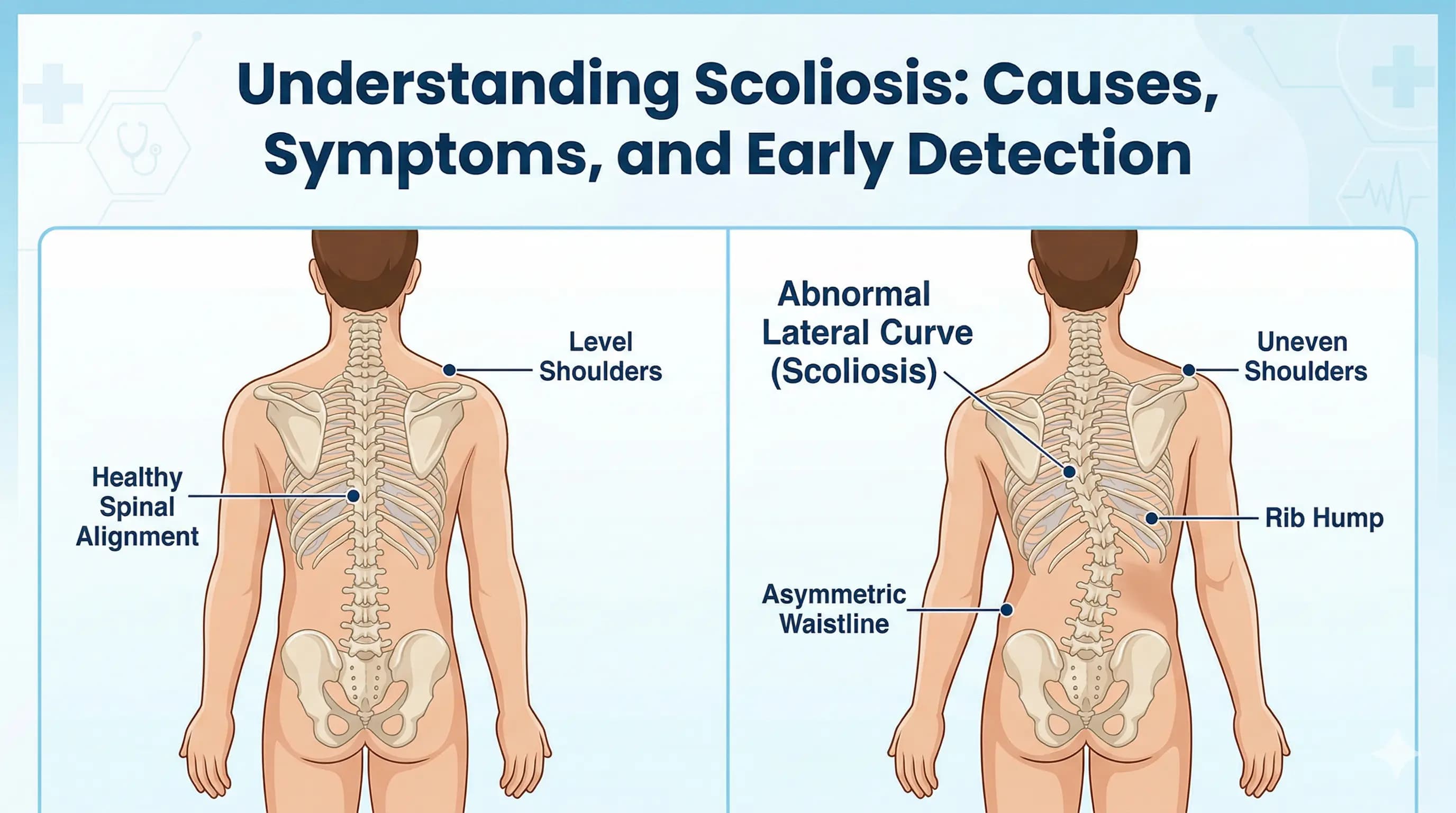
Understanding Scoliosis: Causes, Symptoms, and Early Detection
Scoliosis affects an estimated 2–3% of the global population, yet many cases go undetected until the curvature has already progressed. Early identification is the single most important factor in successful conservative treatment.
What Is Scoliosis?
Scoliosis is defined as a lateral curvature of the spine measuring more than 10 degrees on an X-ray (Cobb angle). Unlike the spine's natural front-to-back curves, scoliosis creates a side-to-side "S" or "C" shape, often accompanied by vertebral rotation.
Common Warning Signs
- One shoulder sitting visibly higher than the other
- A shoulder blade that protrudes more on one side
- Uneven waistline or hips
- The head appearing off-center relative to the pelvis
- Rib prominence when bending forward (Adam's forward bend test)
Types of Scoliosis
The most common form — adolescent idiopathic scoliosis (AIS) — appears during the growth spurt just before puberty. Other types include congenital (present at birth), neuromuscular (linked to conditions like cerebral palsy), and degenerative (developing in adults due to spinal wear).
Why Early Detection Matters
Curves below 25 degrees can typically be managed with physiotherapy and the Schroth method alone. Curves between 25–45 degrees may require a RIGO brace in addition to therapy. Beyond 50 degrees, surgical intervention is often discussed. The window for conservative treatment is widest in the early stages — which is why screening matters.
When to See a Specialist
If you or your child exhibits any of the warning signs above, a clinical examination followed by a standing X-ray is the standard first step. A Cobb angle measurement will determine the degree of curvature and guide the treatment plan.
"The goal of conservative scoliosis treatment is not just to stop progression — it is to actively reduce the curve and restore balanced posture so patients can live without limitation."
At our clinic, we combine the Schroth method, RIGO System brace fitting, and individualized exercise programs to give each patient the best possible outcome without surgery.
Ready to Start Your Recovery?
Book a personal consultation with Dr. Nabeel and take the first step toward a pain-free life.
Book via WhatsApp