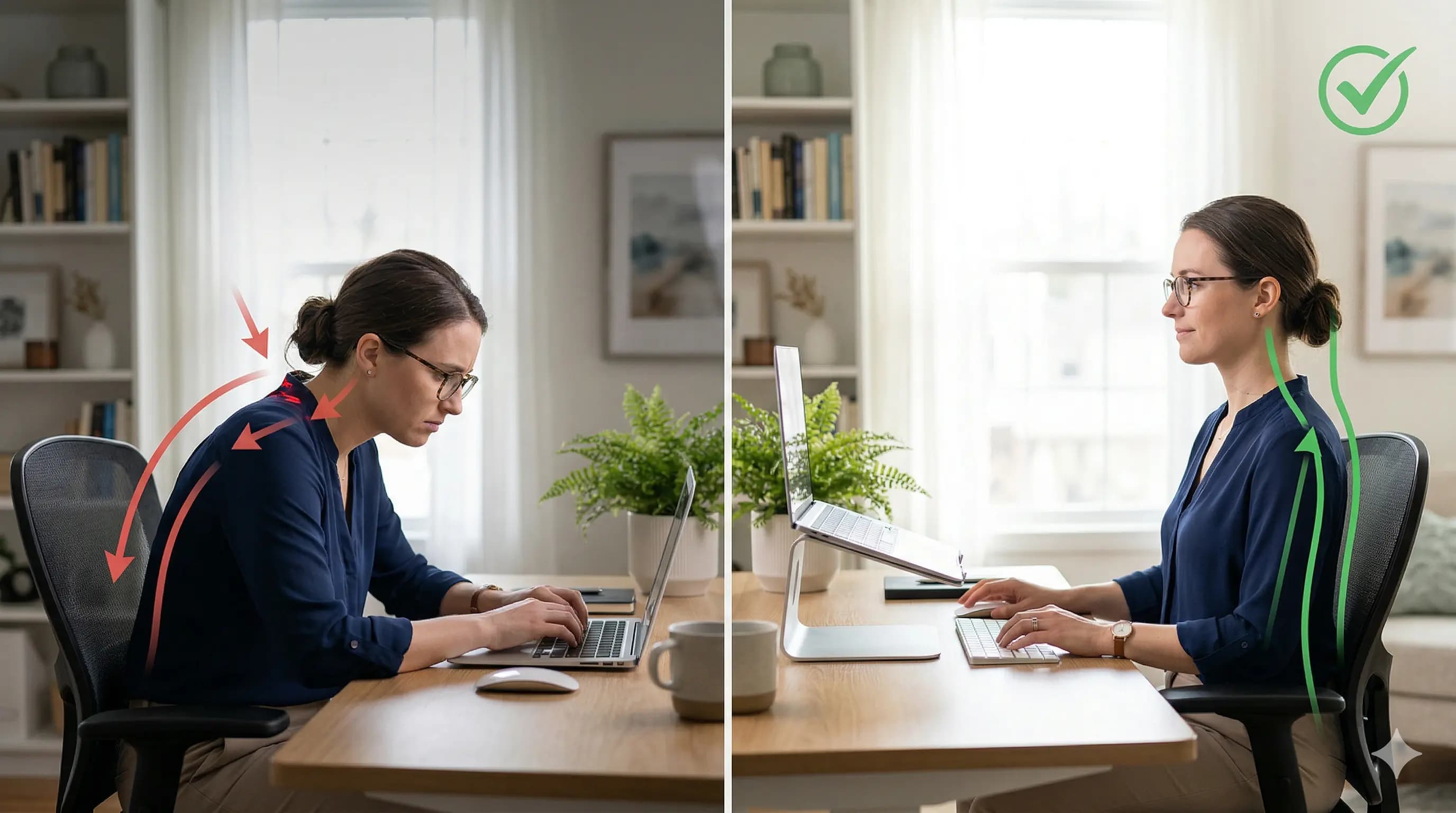
5 Daily Habits That Silently Damage Your Posture (And How to Fix Them)
Most posture problems don't happen overnight. They develop gradually over months and years of repetitive habits — habits so ordinary that most people never question them. The good news is that the same gradual process works in reverse: consistent small corrections create lasting change.
1. Sitting With a Posterior Pelvic Tilt
When you slouch in a chair, your pelvis tips backward (posterior tilt), flattening the lumbar curve and forcing the thoracic spine into a kyphotic (rounded) position. Over time this weakens the lumbar extensors and overloads the intervertebral discs.
Fix: Sit with a slight forward tilt — imagine your sitting bones pointing straight down rather than backward. A small lumbar support or rolled towel at the base of the chair helps maintain this naturally.
2. Forward Head Posture While Using Screens
For every inch the head travels forward of the shoulders, the effective load on the cervical spine increases by approximately 10 pounds. At a 45-degree forward angle, the neck is managing the equivalent of a 49-pound weight.
Fix: Raise your monitor so the top third of the screen is at eye level. Keep your ears directly above your shoulders. Set a reminder to check your head position every 30 minutes.
3. Carrying a Bag on One Shoulder
Habitually hiking one shoulder to stop a strap sliding down trains the trapezius, levator scapulae, and quadratus lumborum on that side to stay in a chronically contracted state. This creates visible asymmetry and contributes to scoliosis-like compensatory patterns.
Fix: Switch to a backpack, or alternate shoulders consciously. Minimise bag weight to under 10% of your body weight.
4. Sleeping on Your Stomach
Prone sleeping requires the neck to rotate fully to one side for hours at a time, compressing the cervical facet joints and shortening the rotator muscles unilaterally. It also forces the lumbar spine into extension.
Fix: Side-sleeping with a pillow between the knees is the most spine-friendly position. If you cannot break the habit, place a thin pillow under your pelvis (not your stomach) to reduce lumbar extension.
5. Not Moving Enough Between Sustained Positions
The intervertebral discs have no direct blood supply — they receive nutrition through the pumping action of movement and load variation. Sustained static postures, whether sitting or standing, starve the discs of this fluid exchange.
Fix: The best posture is your next posture. Set a timer for 25–30 minutes and perform a 2-minute movement break: a short walk, a few thoracic rotations, or a standing hip flexor stretch is enough to restore disc nutrition and reset postural muscle fatigue.
"Posture correction is not about holding a rigid position — it is about building the habit of returning to balance throughout the day."
If you have been struggling with persistent postural pain despite making these changes, a clinical assessment can identify structural imbalances that self-correction alone cannot address.
Ready to Start Your Recovery?
Book a personal consultation with Dr. Nabeel and take the first step toward a pain-free life.
Book via WhatsApp