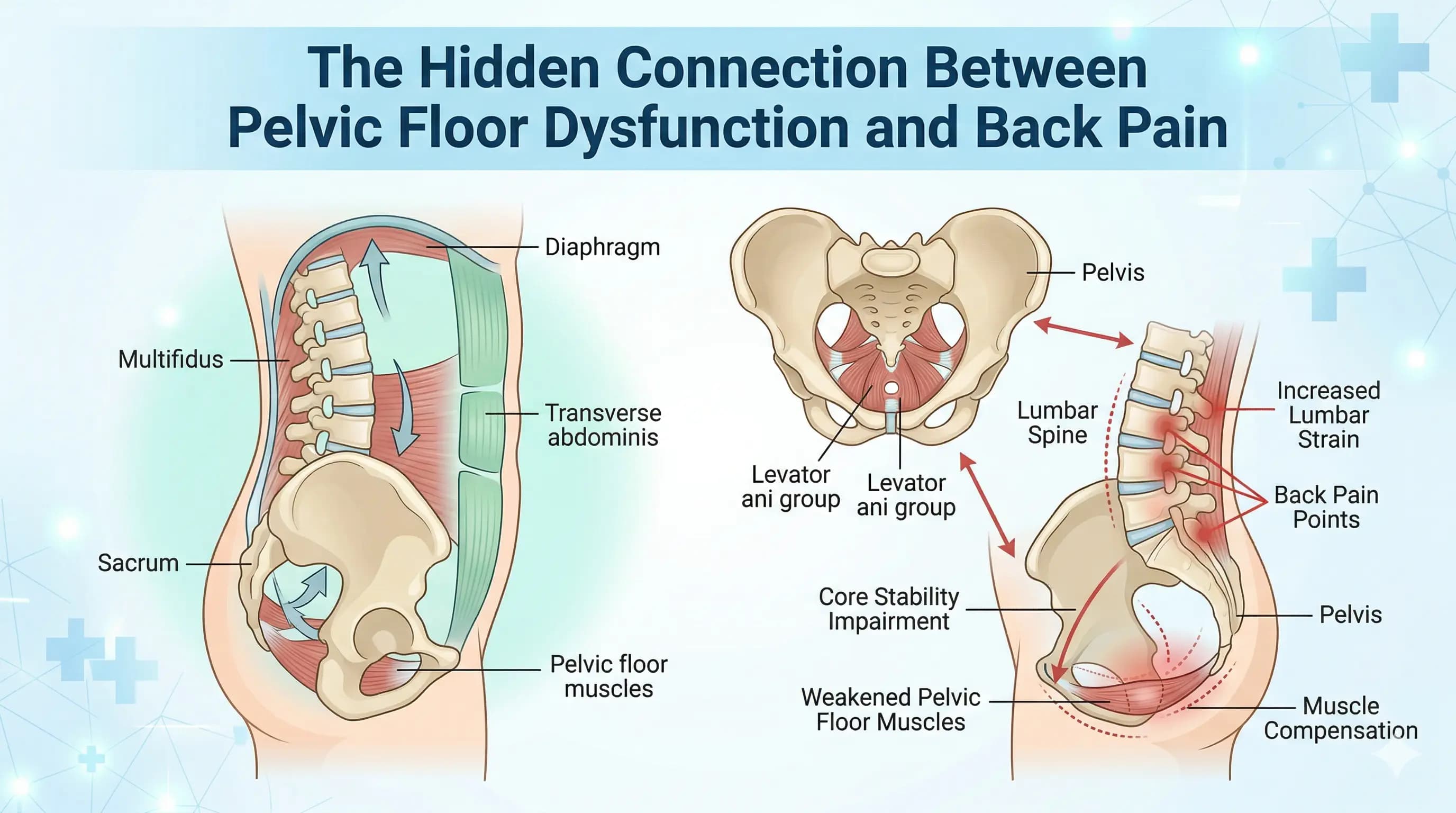
The Hidden Connection Between Pelvic Floor Dysfunction and Back Pain
Chronic lower back pain is one of the most common reasons people visit a physiotherapist. Yet in a significant proportion of cases — particularly in women post-childbirth and in men after prostate procedures — the root cause lies not in the spine itself, but in the pelvic floor.
What Is the Pelvic Floor?
The pelvic floor is a group of muscles, ligaments, and connective tissue that form a hammock-like base at the bottom of the pelvis. These muscles support the bladder, bowel, and uterus, and play a critical role in core stability, posture, and spinal load distribution.
The Core Cylinder
Spinal physiotherapists think of core stability as a pressurised cylinder:
- Top: the diaphragm
- Front and sides: the transversus abdominis
- Back: the multifidus
- Bottom: the pelvic floor
When any one wall of this cylinder is weak or dysfunctional, the entire system loses pressure and the spine bears excessive load. Pelvic floor dysfunction is, in effect, a hole in the bottom of that cylinder.
Signs That Your Back Pain May Have a Pelvic Floor Component
- Lower back pain that worsens with prolonged sitting
- Pain that is relieved by lying down
- Coincident urinary leakage, urgency, or frequency
- Pain during or after sexual intercourse
- A heavy or dragging sensation in the pelvis
How We Treat It
Assessment begins with a functional movement screen and, when indicated, an internal pelvic floor evaluation to determine whether the muscles are overactive (hypertonic) or underactive (hypotonic). Treatment is tailored accordingly and typically includes:
- Manual therapy to release trigger points and restore mobility
- Neuromuscular re-education — learning to activate and relax the pelvic floor in coordination with breathing
- Progressive core stabilisation exercises
- Postural and movement habit correction
Most patients see measurable improvement within 6–8 sessions when they follow their home program consistently.
Ready to Start Your Recovery?
Book a personal consultation with Dr. Nabeel and take the first step toward a pain-free life.
Book via WhatsApp